Free to use
Free tools for writers.
Each studio is a separate site, built for one job: the opening sentence, the contract, the prize deadline, the day’s word count. Open what you need. Accounts not required.
On the page
Openings, structure, names, language, and the genres that set the rules.
A craft studio for novel openings
The First Line
How to write a first sentence that keeps a promise. Principles, tests, and a private reading of the line you are about to send into the world.
Open The First Line →
A plot atlas for novelists and screenwriters
Threshold
Map a story against Campbell, Vogler, Harmon, Murdock, Hudson and Snyder — the stations of the hero’s journey, laid out so you can see where the draft actually is.
Open Threshold →
Names with meaning
Nomina
Choose a grain — origin, temper, element, role — and receive given names and surnames whose etymologies fit the character you are writing.
Open Nomina →
A literary character workshop
Dossier
Build round characters with nine sections of lists — class, accent, desire, trauma, politics, and the lie they live by. The dossier writes itself as you choose.
Open Dossier →
A studio for aspiring poets
The Poet’s Craft
Technique first: metre, rhyme, imagery, language, free verse and traditional forms — then the groups, presses and prizes that keep a poem alive in the world.
Open The Poet’s Craft →
A private frequency checker
Word Census
Count every word in a manuscript on your own machine. Flags repeated long words, sets names aside, and suggests alternatives. Nothing is uploaded.
Open Word Census →
A book idea generator
Storywell
Choose a genre, add a place or a scrap of an idea, and receive a title, a logline and a full story summary — or a chapter-by-chapter contents list for non-fiction.
Open Storywell →
Young adult fiction
The YA Desk
A studio for the 12–18 age band: sub-genres, tropes, craft and the market facts of young adult fiction, written at the speed a teenager actually lives.
Open The YA Desk →
Historical fiction
The Scriptorium
A working guide to novels set in a past the writer did not live: what the genre promises, how the era constrains the characters, and how the market reads that promise.
Open The Scriptorium →
At the desk
Hours, word counts, company, a spoken manuscript, and the decision to write when the mood has left the room.
When inspiration is absent
Write Anyway
Exercises, prompts, and a quiet desk for getting words down without waiting to feel like a writer. Built from fifty books’ worth of starting anyway.
Open Write Anyway →
The hours are already in the week
Found Time
Companion to How to Find Time to be a Writer. Locate the hidden pockets in an ordinary week and turn 250 words a day into a draft over a year of unremarkable days.
Open Found Time →
Log the day’s work
Quillmark
A blotter for daily word counts: set a target, watch the week and the month fill, and keep a twelve-week record of the manuscript as it grows.
Open Quillmark →
Find the room where the work belongs
The Writing Circle
A catalogue of writing groups — local rooms and online circles — filtered by place, genre and whether you want a chair in the room or a screen.
Open The Writing Circle →
A manuscript, spoken
The Listening Room
Turn a manuscript into a free audiobook. Choose a narrator, listen on the page, then download one file or a set of chapter files. Nothing is stored on the server.
Open The Listening Room →
In the trade
Money, contracts, agents, queries, prizes, book fairs, rejection, and the publicity that happens after the book exists.
The desk is only one of the rooms
How Writers Earn
A field guide to thirty-four ways a writer is paid: rights, audio, festivals, teaching, self-publishing, commissions, and the work that sits beside the book.
Open How Writers Earn →
Read the deal before you sign it
Inside the Contract
Royalties, advances, subsidiary rights and the clauses that decide what a UK or US book deal actually means. A field guide, not a scare story.
Open Inside the Contract →
What an agent does, and how to get one
The Writer’s Guide to Agents
Whether you need representation, typical fees, how to approach an agent, and a directory of literary and film agencies you can sort by region and type.
Open The Writer’s Guide to Agents →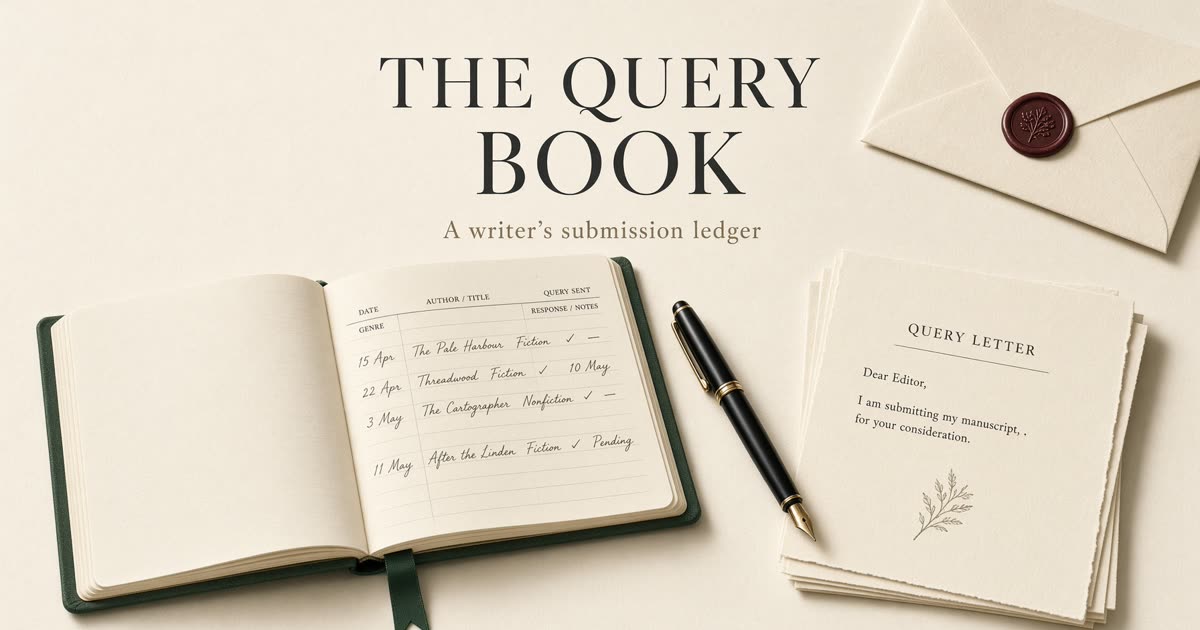
Manuscript and script submission tracker
The Query Book
A private ledger of what you sent, to whom, and when to follow up — agents, publishers and producers, so nothing sits forgotten in an outbox.
Open The Query Book →
Book publicity, without the agency
The Author’s Desk
Press releases, local shops, libraries, papers, and the specific, nearby work that competes with a marketing budget you do not have.
Open The Author’s Desk →
Find the next prize worth entering
The Prize Calendar
A deadline-ordered directory of writing competitions worldwide — short stories, poetry, novels, memoir and scripts — filterable by genre, age and region.
Open The Prize Calendar →
Book fairs for authors
Author Fair Guide
An almanac of publishers’ book fairs — Frankfurt, London, Bologna and the rest — and how a working writer walks the halls, meets the smaller presses, and leaves a sample rather than a manuscript.
Open Author Fair Guide →
A publisher’s guide
Why Books Get Rejected
Publishers turn down about 98% of proposals. Many of those nos never needed to happen. The avoidable mistakes, the harder truths about the market, and a checklist before you hit send.
Open Why Books Get Rejected →